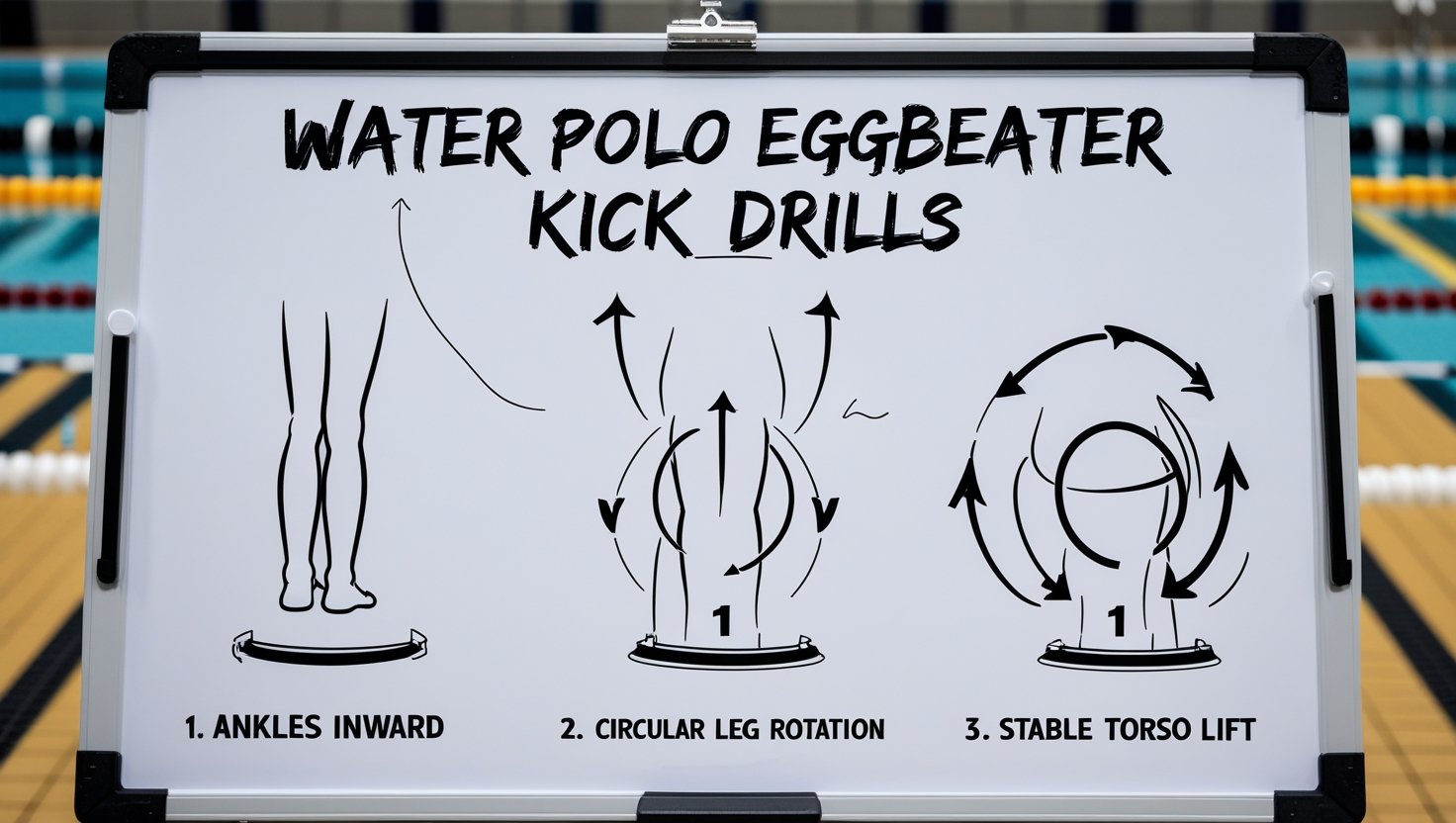
Ever watched a water polo player effortlessly hovering above water while fending off opponents? That’s the magic of the eggbeater kick, the invisible foundation supporting every great water polo player. Mastering this technique doesn’t just improve your game; it transforms you from a participant into a formidable competitor.
The Vertical Chess Match:
Unlike swimming’s horizontal kicks, the eggbeater creates sustained vertical stability through continuous rotational leg movements. This isn’t just another swimming technique; it’s water polo’s most fundamental core skill, allowing players to elevate their upper bodies while keeping hands free for catching, throwing, and defending.
What makes the eggbeater extraordinary isn’t just its effectiveness but its counterintuitive nature. Your legs move in opposing circular patterns, like egg beaters in a mixing bowl, creating constant upward force. Players who master this technique gain a decisive tactical advantage, able to maintain position without exhausting vital energy reserves.
Mastering Basic Mechanics:
Before diving into complex drills, establishing proper eggbeater mechanics creates the platform for everything that follows. Many coaches observe that technique flaws established early become increasingly difficult to correct later in a player’s development.
Start with the “Wall Sit” drill, holding position with your back against the pool wall, knees bent at roughly 90 degrees, feet turned outward. Focus on creating small, continuous circles with each foot moving in opposite directions. This isolated practice builds proper muscle memory without the challenge of full water support.
Progress to “Hands Out” drills, where you perform the eggbeater while holding arms straight out of the water. The key insight many players miss is that height comes from kick efficiency, not kick power. Efficient eggbeaters use hip rotation and proper foot positioning rather than muscling through with brute force. Practice maintaining consistent height with minimal splash, excessive turbulence indicates wasted energy.
The Forgotten Training Principle:
The secret to developing extraordinary eggbeater strength lies in applying progressive resistance, systematically increasing difficulty as your capabilities grow. This approach builds kick endurance far more effectively than simply repeating the same drills.
The “Weighted Eggbeater” provides one of the most effective resistance training methods. Start with small ankle weights (0.5-1 lb.) and maintain height for 30-second intervals. As strength improves, gradually increase duration before adding weight. This builds specific strength in exactly the movement patterns required during actual gameplay.
Another powerful progression incorporates medicine ball drills. Hold a medicine ball at chest height while eggbeatering for 30 seconds, then press it overhead for another 30 seconds. The shifting center of gravity forces continuous adaptation in your kick, developing the responsive adjustments needed during dynamic game situations.
The Lateral Dimension: Mobility Mastery:
Static eggbeater strength represents only half the equation; the ability to move efficiently while maintaining height separates elite players from average ones. Surprisingly, many training programs overemphasize vertical power while neglecting lateral mobility.
“Square Pattern” drills address this gap by having players trace a square pattern in the water, moving forward, right, backward, and left while maintaining consistent height. The critical technique isn’t pushing with the legs but rather adjusting the angle and emphasis of the circular motions. Moving forward increases emphasis on the backward portion of both leg circles, while moving right emphasizes the backward motion of the right leg and forward motion of the left.
“Partner Defense” drills elevate mobility training by introducing reactive elements. Partners alternate playing offense and defense, with offensive players attempting direction changes while defensive players mirror their movements. This develops the situational awareness and immediate adaptability essential during gameplay, where maintaining an optimal defensive position often determines success or failure.
Building the Gas Tank:
Even perfect technique becomes ineffective when fatigue sets in. Water polo’s intense nature demands specialized endurance training focused on the unique demands of continuous eggbeater kicking.
“Pyramid Intervals” offer one of the most effective endurance-building approaches. Start with 30 seconds of maximum-height eggbeater followed by 30 seconds of active recovery (light eggbeater just high enough to keep your chin above water). Progress through 45-second, 60-second, 90-second, and 120-second intervals before working back down the pyramid. This training method builds both the aerobic and anaerobic energy systems required for game situations.
The often-overlooked “Hands-Up Defense” drill combines endurance with game-specific positioning. Players maintain a defensive position with both hands up (simulating shot blocking) for extended periods while a partner moves unpredictably. The sustained arm elevation increases cardiovascular demand while building specific endurance in a defensive posture, precisely when the powerful eggbeater becomes most crucial in games.
The Multitasking Challenge:
The ultimate test of eggbeater mastery isn’t performing it in isolation but maintaining proper technique while simultaneously handling the ball. Many players show excellent kick mechanics during drills but revert to inefficient patterns when attention shifts to throwing, catching, or shooting.
“Figure-8 Passing” challenges this integration by having players maintain height while passing a ball in a figure-8 pattern around their head and torso. The constantly changing arm positions and weight distribution force continuous kick adjustments. The key insight is maintaining consistent hip and knee positioning despite the upper body movements.
Progress to “Shot Sequence” drills where players catch, establish position, and shoot, all while maintaining optimal height through effective eggbeater. Focus on maintaining kick rhythm regardless of upper body actions. Many coaches note that shot accuracy improves dramatically when players maintain stable lower body support rather than compensating with decreased height during the shot motion.
Bridging Practice and Performance:
The final progression in eggbeater training bridges the gap between controlled practice and chaotic game situations. Even players with excellent isolated skills often struggle when facing the combined challenges of defenders, fatigue, and tactical decision-making.
“Defensive Gauntlet” drills simulate game intensity by having one player maintain position while multiple defenders create interference without fouling. The offensive player must continuously adjust the eggbeater technique to maintain position and height despite the defensive pressure. This develops the adaptability required during critical game moments when perfect technique becomes difficult to maintain.
“Fatigue Shooting” drills acknowledge the reality that the most important shots often come when players are most exhausted. After high-intensity swimming or eggbeater intervals, players must quickly establish position and take quality shots. This trains not just physical endurance but the mental discipline to execute proper technique despite exhaustion, perhaps the most valuable skill in competitive water polo.
Conclusion:
Mastering the eggbeater kick transforms your water polo potential, creating the foundation for all other skills. Through progressive training, you’ll develop the strength, mobility, and endurance needed for competitive success.
FAQs:
1. What makes the eggbeater kick different from treading water?
The eggbeater uses alternating circular leg movements for maximum efficiency and height, while basic treading uses scissor kicks that provide less stability and require more energy.
2. How long should beginners practice the eggbeater daily?
Beginners should start with 3-5 sessions of 10-15 minutes weekly, focusing on proper technique before increasing duration or adding resistance.
3. What’s the most common mistake in eggbeater technique?
The biggest mistake is pointing toes during the kick. Always maintain flexed ankles with feet turned outward to maximize surface area against the water.
4. How high should I be able to eggbeater out of water?
Competitive players typically aim to maintain height from mid-chest to shoulders above water, with defensive positions requiring higher elevation.
5. Can land exercises improve my eggbeater kick?
Yes! Core strength training, hip mobility exercises, and rotational ankle movements significantly improve eggbeater performance when combined with in-water practice.
6. How do I know if I’m doing the eggbeater correctly?
Proper technique creates minimal splash, steady height, and allows you to maintain position without drifting. Video analysis can help identify areas for improvement.